
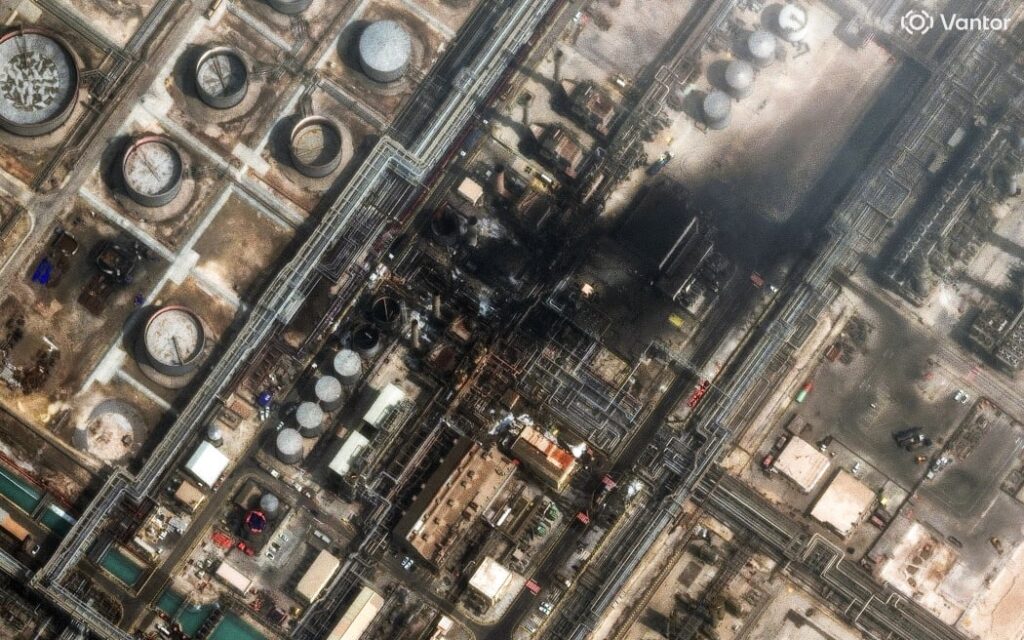
Featured image: Satellite image © 2026 Vantor via AFP.
WHAT IS HAPPENING IN THE MIDDLE EAST, AND WHAT IS IT GOING TO COST US?
By Tommy J. Housman | November 25, 2026
I've spent a considerable amount of time recently trying to understand what is happening in the Middle East. One of the frustrations I have is how difficult it has become to follow this war through American news coverage. Who is bombing whom? What infrastructure is being destroyed? How much of it has already been damaged, and what are the economic consequences of continuing to destroy it? These are questions I think Americans should be asking, particularly as we approach Christmas and head into another year of economic uncertainty.
One of the people I've been following is Matt Randolph, better known as Mr. Global, who has experience in the oil and gas industry. His coverage has encouraged me to look more closely at crude oil production, refining capacity and the global distribution of petroleum products. The more I research these issues, the more concerned I become about what we could experience over the next several months.
SAUDI ARABIA IS NOW DEALING WITH AN EXPANDING WAR
On Wednesday, November 25, Yemen's Iran-aligned Houthis said they attacked Saudi Arabia's Ras Tanura refinery, the country's largest. Reuters reported that a source with knowledge of the matter confirmed an attack and that NASA and Planet Labs satellite imagery showed thick smoke. Saudi-led forces said they intercepted four drones in Ras Tanura, but did not say the refinery had been struck. The extent of damage and any production loss remained unconfirmed.
The war involving the United States and Iran has expanded into a wider regional conflict, with Saudi Arabia facing renewed Houthi attacks and commercial shipping under continued pressure. I'm trying to understand how much longer the international energy industry can absorb these disruptions without Americans experiencing another substantial increase in the cost of living.
We are approaching nine months of war. Infrastructure that has been damaged has to be repaired, equipment has to be replaced, workers have to be able to return safely, and companies have to be willing to continue operating in an increasingly unstable region. How much of that recovery is possible when the fighting continues?
THE NUMBERS THAT CONCERN ME
The International Energy Agency's November report is worth reading. Global oil inventories were down a net 462 million barrels since the war began, even after a recovery of 52 million barrels in October. Oil inventories on land remained at their lowest level since at least 2016.
In October, Gulf crude exports reached 82% of their prewar levels, while refined products and LPG remained at approximately half of their prewar levels. European diesel prices were still 77% higher than before the war. The IEA expects global oil supply to exceed demand in the fourth quarter, but it also describes a continuing shortage of refined products, especially diesel.
I don't understand why we aren't having more conversations about these numbers. There has been some legitimate recovery in global oil production. That's encouraging, and I hope it continues. The attacks we are seeing this week introduce additional uncertainty into an industry that is still trying to recover.
GLOBAL OIL INVENTORIES
Observed inventory changes reported by the IEA. Bar lengths compare absolute magnitudes; figures have different time periods.
Net since war began
−462 million bbl
October total change
+52 million bbl
Oil held at sea in Oct.
+86 million bbl
Source: IEA, Oil Market Report, November 2026.
GULF EXPORTS
October 2026 level as a share of pre-war levels.
Crude oil
82%
Refined products + LPG
≈50%
Source: IEA, Oil Market Report, November 2026.
WHY I AM PARTICULARLY CONCERNED ABOUT DIESEL
Most Americans measure the cost of oil by what they see when they pull into a gas station. I do it myself. When gasoline drops below three dollars a gallon here in Indiana, I'm relieved because that's a little more money I have available for something else.
But practically everything I purchase has been transported using diesel fuel at some point. The food I buy, the materials used to maintain our homes, the agricultural equipment that produces our food, the packages delivered to our doors and the merchandise we're purchasing for Christmas all depend, to varying degrees, on diesel.
On November 25, Fuelwide reported an Evansville average of $2.98 for regular gasoline and $6.16 for diesel. American refineries are operating at elevated levels to help meet demand, including international demand. The EIA's November 25 weekly report lists 105.6 million barrels of U.S. distillate fuel oil in stock for the week ending November 20, down 5.9% from the same week a year earlier. That report predates today's reported attack.
On November 10, the EIA released a revised forecast for 2027. It raised the projected average diesel price from $4.49 to $5.03 per gallon, and gasoline from $3.56 to $3.73. Those forecasts were completed November 5. The agency still anticipates lower fuel prices in 2027 than in 2026, but what happens to those projections if the destruction of refining infrastructure continues?
EVANSVILLE FUEL PRICES
AAA daily metro averages per gallon on November 25, 2026.
Regular gasoline
$2.98
Diesel
$6.16
Source: AAA data reported by Fuelwide, Evansville metro, November 25, 2026. Individual station prices vary.
U.S. DISTILLATE INVENTORIES
Stocks of distillate fuel oil, million barrels, for comparable weekly reports.
Nov. 20, 2026
105.6 million bbl
Nov. 21, 2025
112.2 million bbl
Source: U.S. EIA Weekly Petroleum Status Report. The 2026 report predates the November 25 refinery report.
EIA 2027 RETAIL FUEL FORECASTS
November forecast compared with the October forecast, dollars per gallon.
Gasoline · October
$3.56
Gasoline · November
$3.73
Diesel · October
$4.49
Diesel · November
$5.03
Source: U.S. EIA, Short-Term Energy Outlook, November 10, 2026.
WHAT IS THE TRUMP ADMINISTRATION’S LONG-TERM PLAN?
I would like to have a much better understanding of what the Trump administration believes it is accomplishing at this point and what it believes the economic consequences will be for the American people.
What is the anticipated duration of this war? How much additional damage to the global energy supply does the administration anticipate? What preparations are being made to protect American consumers from the economic consequences? How long can this continue before the cost of maintaining the current strategy exceeds whatever benefit the administration believes it will achieve?
I haven't seen adequate answers to those questions. Someone who is financially secure can absorb another dollar per gallon, an increase in the cost of groceries or a few hundred dollars in additional annual utility expenses. Millions of American families cannot.
WHAT CAN WE EXPECT THROUGH CHRISTMAS?
I wish I could provide a definitive answer. Gasoline prices have declined in recent weeks. Recovering supplies, reduced demand and improving domestic inventories could allow those declines to continue. Reuters reported that crude prices rose on November 25 after the latest claimed refinery attack, however, and that is a reminder of how quickly market conditions can change.
If the damage is extensive, if commercial shipping becomes increasingly difficult or if the war continues to disrupt the production and distribution of petroleum products, American fuel prices could rise again. Wholesale prices can react quickly; broader consumer costs generally take longer.
Natural gas is somewhat more complicated. Reuters reported that Qatar's LNG vessel berthings reached 36 by November 25, compared with 35 in all of October and 21 in September. The EIA projects U.S. Henry Hub wholesale gas will average $2.87 per million Btu from November through March. Domestic winter weather, inventories and utility rate structures will have considerable influence over what we pay here.
What I'm particularly concerned about over the Christmas season is the continued cost of diesel and what that could mean for transportation, distribution and the price of consumer goods. I cannot tell you what gasoline will cost on Christmas Day. The evidence does not support that level of certainty.
QATAR LNG VESSEL BERTHINGS
Vessel berthings at Ras Laffan; November count through November 25.
September 2026
21
October 2026
35
November to date
36
Source: Kpler data reported by Reuters, November 25, 2026. Berthings are not the same as export volume.
HOW MUCH MORE CAN AMERICAN FAMILIES ABSORB?
I think about these issues because, like many Americans, I have a household budget that doesn't leave much room for additional expenses.
For families already struggling to afford housing, electricity, food, transportation and healthcare, another increase in the cost of living can have devastating consequences. There are only so many things people can eliminate from their household budgets before they begin eliminating things they actually need.
I hope I'm wrong about the severity of what we could experience over the coming months. I hope the damage to Saudi Arabia's refinery is minimal, that energy production continues to recover and that there is some diplomatic resolution to this war.
But I cannot look at the expansion of military activity throughout the Middle East, the continuing destruction of energy infrastructure, the depletion of global inventories and the federal government's upward revisions to fuel price forecasts without being concerned.
I intend to continue following the reporting, listening to people with actual experience in the oil and gas industry and examining the data as it becomes available. If the evidence changes, my understanding of the situation will change with it.
In the meantime, I think the American people deserve a considerably better explanation of what is happening, how long we should expect it to continue and what we are ultimately going to be expected to pay for it.
Sources and additional reading
- Reuters, November 25 — refinery claim and market reaction
- Reuters syndicated by Al-Monitor — refinery and satellite imagery
- IEA — November Oil Market Report
- EIA — November Short-Term Energy Outlook
- EIA — Weekly Petroleum Status Report
- Reuters — U.S. inventory report
- Fuelwide — Evansville metropolitan fuel prices
- AAA — Indiana fuel prices
- Reuters/Kpler — Qatar LNG shipping
- Matt Randolph / Mr. Global