
Thanksgiving editorial · November 26, 2026
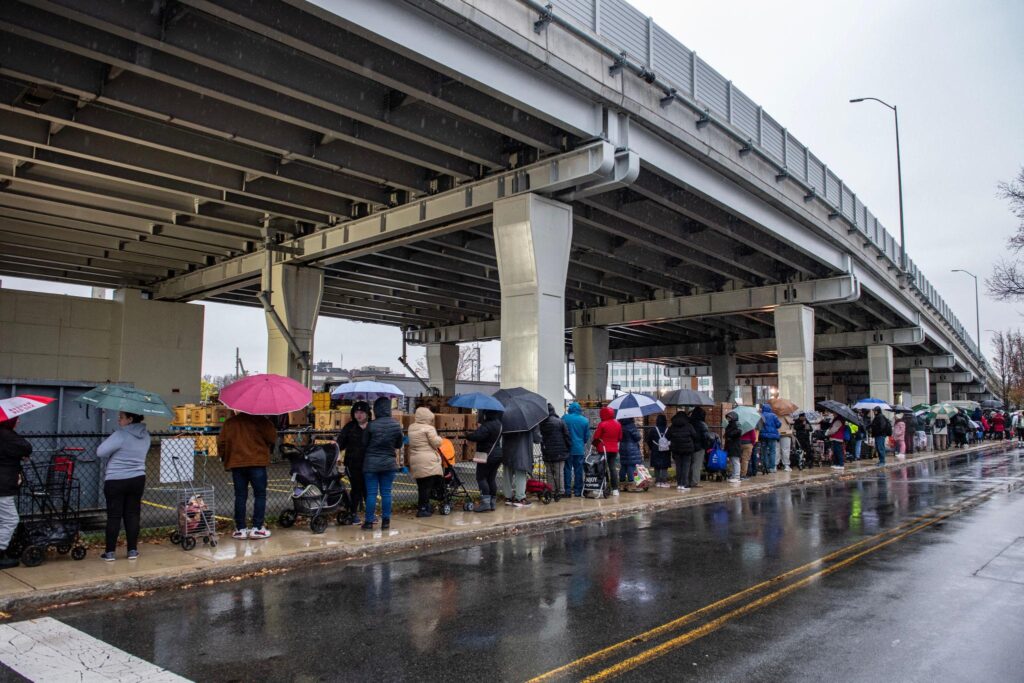
Today, millions of Americans will gather around tables with their families and friends. There will be turkey, stuffing, mashed potatoes, dumplings and, in many households, more food than everyone sitting around the table could possibly consume. There will be leftovers for days. But while we enjoy that abundance, I want us to spend some time contemplating the people who will go without food today, the families who have been separated, and the political decisions that have contributed to their suffering.
The politics of hunger
According to the World Food Programme, approximately 266 million people worldwide faced acute hunger in 2025. War, climate change, economic instability and rising food and energy costs have contributed to this crisis. At the same time, the Trump administration has substantially reduced American humanitarian assistance and dismantled USAID’s independent operations, disrupting programs designed to prevent hunger, disease and starvation.
The World Food Programme now plans to assist just 91 million people in 2027 because available funding has failed to keep pace with humanitarian needs.
1 / Global hunger · 2025 estimate / 2027 plan
266 million people facing acute hunger
Acute hunger in 2025 266M
WFP’s 2027 assistance target 91M
$12.1 billion requested for 2027
Call it government efficiency. Call it eliminating waste, fraud and abuse. Whatever terminology you choose, the consequences for people who depend on that assistance deserve to be acknowledged. Food assistance is not simply a number on a government spreadsheet. It is food that real human beings depend upon to survive.
And this is not just happening overseas.
The legislation Trump signed on July 4, 2025, is projected to reduce federal nutrition assistance spending by approximately $187 billion through 2034. His administration also canceled deliveries of approximately 94 million pounds of food intended for American food banks. Meat, eggs, dairy products and vegetables that were supposed to reach struggling American families never arrived.
These are documented decisions, not hypothetical consequences of some future policy.
2 / United States · May–September 2025
94 million pounds of food canceled
Each block represents approximately 1 million pounds.
4,304 deliveries canceled · $500 million in funding withdrawn
3 / Federal nutrition spending · FY2025–2034
$187 billion in projected reductions
Each complete square = $10 billion; partial square = $7 billion.
Meanwhile, according to United For ALICE’s latest national report, approximately 41% of American households do not earn enough to reliably afford the basic necessities of life. That represents more than 54 million households struggling to afford housing, food, transportation, health care and other essential expenses.
We are reducing food assistance in a country where millions of working people already struggle to feed themselves.
4 / United States · 2024 household data
54.5 million households below the ALICE threshold
Below federal poverty level 12.5% · 16.5M
ALICE: above poverty, below basic costs 28.8% · 38.0M
Above the ALICE threshold 58.7% · 77.4M
41.3% below the threshold in total
The people who put food on our tables
While you’re enjoying your Thanksgiving dinner, think about the people who made that dinner possible. Think about the people who planted, harvested, processed, packaged and transported that food.
According to the United States Department of Agriculture, approximately 68% of hired crop farmworkers were foreign-born between 2020 and 2022. Approximately 42% of all hired crop farmworkers lacked work authorization.
America built an agricultural economy that depends heavily on immigrant labor, including labor performed by people without legal authorization to work here. American businesses hired them. American consumers benefited from their labor. Successive American governments allowed this economic arrangement to continue for decades.
We built the conveyor belt.
5 / U.S. hired crop farmworkers · 2020–2022
68% foreign-born · 42% without work authorization
U.S.-born 32%
Naturalized U.S. citizens 7%
Other authorized immigrants 19%
Without work authorization 42%
Now we are aggressively enforcing immigration laws against people whose labor our own economic system has depended upon.
Imagine encouraging someone to perform a particular task every day for years, benefiting from their work, and then suddenly treating that person as the sole problem without acknowledging your own participation in the arrangement.
Where is the accountability for the businesses that employed these people? Where is the accountability for the political institutions that allowed this system to continue? Where is the conversation about creating a workable legal pathway, paying people fairly and protecting them from exploitation?
These people are human beings. They have families, children, ambitions and dreams. They want safe homes, employment and opportunities for their children, just as the rest of us do.
The cost of our choices
Immigration enforcement also has economic consequences. Removing workers from industries that depend on their labor can disrupt production, increase labor costs and contribute to higher consumer prices.
Tariffs impose additional costs on imported food, agricultural equipment, packaging and other supplies. Those costs can travel through the production and distribution system before eventually reaching the grocery store.
I can walk into a grocery store today and spend approximately $50 on a package of chicken and a package of beef to feed a family of three or four.
But the cost of groceries is not even the most important part of this conversation.
The most important part is how we treat other human beings.
Immigration enforcement has separated families and detained people without criminal convictions. Reducing the entire immigrant population to a criminal stereotype ignores both the individual circumstances of these people and the economic system in which they participate.
We should be discussing how to give these workers a fair opportunity to participate legally in the economy rather than continuing a system that exposes them to exploitation.
What does it mean to be an American?
The American promise has long been associated with the opportunity to build a better life, escape oppression and establish a future for oneself and one’s family.
Many of our ancestors came here seeking precisely those things. Other people were already here before European settlement, and millions were brought here against their will. Our history is complicated, and our nation has never fully realized its stated ideals.
But the aspiration that people should have the opportunity to build a dignified life remains worth defending.
What does that aspiration mean when more than 54 million American households cannot afford the basic necessities of life? What does it mean when people who help produce our food cannot safely participate in our economy? What does it mean when our government reduces the resources available to feed hungry children?
These are questions about the kind of society we are building and the values our public policies actually reflect.
What does it mean to be a Christian?
There is something particularly disturbing about the disconnect between publicly professed Christian values and indifference toward human suffering.
In Matthew 25, Jesus speaks explicitly about feeding the hungry, welcoming strangers and caring for people in need. He identifies the treatment of vulnerable people as a measure of how people treat him.
There is nothing ambiguous about that instruction.
Religious identification is not a substitute for compassion. Attending church is not a substitute for feeding hungry people. Public declarations of faith do not erase the consequences of decisions that affect the lives of others.
If we claim to believe that human life is sacred, that belief should extend to a hungry child overseas, an American family relying on food assistance and an immigrant worker trying to provide for their children.
Our compassion should not end at a national border.
Enjoy your Thanksgiving
Today, while you enjoy your turkey, stuffing, dumplings and everything else sitting on your table, think about the people who do not have those things.
Think about the American parents wondering how they will feed their children next week. Think about the children whose parents have been detained or deported. Think about the agricultural workers whose labor made your dinner possible. Think about the millions of people around the world who face starvation while humanitarian organizations struggle to obtain funding.
And think about whether the political decisions you support are consistent with the moral and religious values you claim to possess.
Political decisions are not abstract. They determine who receives assistance, who has access to food, how families are treated and what opportunities are available to people trying to survive.
Enjoy your turkey.
But understand that gratitude means considerably more when it is accompanied by compassion, responsibility and a willingness to confront the suffering of others.
Sources and data notes
- World Food Programme — 2027 assistance plan, November 20, 2026; 2025 acute hunger estimate and 2027 assistance target.
- Congressional Research Service — SNAP and Related Nutrition Programs in P.L. 119-21, August 15, 2025; CBO spending estimates for FY2025–2034.
- ProPublica — Trump Canceled 94 Million Pounds of Food Aid. Here’s What Never Arrived., October 3, 2025; USDA delivery records.
- United For ALICE — The State of ALICE in the United States: 2026 Update on Financial Hardship; 2024 household data.
- USDA Economic Research Service — Farm Labor; NAWS hired crop farmworker data, 2020–2022.
- Matthew 25:31–46; the religious passage discussed in this editorial.
The five graphics distinguish historical observations from prospective plans and budget projections. The grocery example is a personal observation, not a national price average. The policy judgments and moral conclusions are the author’s opinion.