A local conversation about data centers becomes a larger story about public participation—and who gets a voice in the future of a community.
When Kristen Trombley and Jason Nab joined me for Episode Two of Gaslit: The Power of Story, the conversation was supposed to be about data centers in Posey County. It was, but it also became something much larger. What we really talked about was what happens when ordinary people discover that decisions capable of changing their community are already moving around them, often faster than the public can understand them, and they decide they are not going to sit quietly while somebody else determines what their future will look like.
Neither Kristen nor Jason entered this process as a political organizer or data center expert. Kristen is a stay-at-home mother of four boys. Jason farms land in Posey and Vanderburgh counties with his wife’s family, whose farm has been in the family for 175 years. Jason told me that less than a year ago, he barely knew what a data center was. Then landowners around the family farm began being contacted about selling property, and the area where they farm appeared to be directly in the path of a proposed development.
He was eventually offered what he described as an astronomical amount of money for part of the land. He turned it down. There was not enough money in the world, he said, to make that decision for him.
Kristen arrived at the issue from another direction. She had begun researching artificial intelligence because she wanted to better understand the technological world her children were growing up in. That research led her to data centers, and then to what was happening in Indiana. She came across a Facebook post asking whether anyone else in Posey County had been approached about selling land. A few phone calls and conversations turned into a meeting that unexpectedly drew around 100 people and members of the media. Within weeks, Protect Posey County had an online presence, an email list, regular meetings and eventually thousands of members.
What struck me during the interview was how quickly both of them had been forced to learn an entirely new language. Zoning. Ordinances. Setbacks. Utility infrastructure. Public records. Area plan commissions. County commissioners. Transmission lines. Water use. Megawatts. They learned because they had to. They also learned something more important: being angry is not enough. If you want to influence what happens in your community, you have to understand the process well enough to participate in it.
Kristen talked about how Protect Posey County tried to make sure that when they raised a concern, there was evidence behind it. They researched ordinances in other communities, attended local meetings and tried to give officials information that could justify stronger protections. That distinction matters. This was not simply a group of people saying, “We do not want this.” They were asking specific questions about what the development could mean for water, farmland, electrical infrastructure, environmental conditions, utility rates and surrounding property owners.
Those questions are reasonable because the scale of the proposed development is enormous. During the interview, we discussed a possible Amazon Web Services project in Posey County and the infrastructure that could accompany it. Publicly available information has confirmed that Amazon Web Services has been evaluating a possible data center in Posey County and that the company moved away from an earlier location under discussion. No data center has been approved, and public records have not conclusively established every connection among the different project names, proposed sites and infrastructure being discussed. That uncertainty is itself one of the central problems.
If a project could consume hundreds of acres, require massive amounts of electricity, bring new transmission infrastructure across private land and potentially affect water use and utility costs, then the public should not have to piece together what is happening through rumors, accidental discoveries and records requests. Transparency should not be something citizens have to fight for after decisions are already moving. It should be the starting point.
The environmental and economic questions are equally complicated. Posey County already carries the legacy of heavy industry, and Kristen raised concerns about adding new demands to a community that is not starting from a clean slate. Jason talked about farmland in a much more personal way. Once productive farmland is covered in concrete and industrial infrastructure, you cannot simply pretend it is interchangeable with what existed before. He described the agricultural ground as something that took generations to build and something that cannot simply be recreated later because a decommissioning plan exists on paper.
The conversation eventually moved where I expected it would move: artificial intelligence and the future of work. Data centers are not simply large buildings full of computers. They are physical infrastructure for the digital economy we are rapidly constructing, and increasingly they are part of the infrastructure required to train and operate artificial intelligence systems. Amazon has publicly identified large-scale computing infrastructure in Indiana that supports Anthropic AI workloads, although no public information establishes what a future Posey County facility would specifically be used for.
That difference is important, but it does not make the larger question go away. What are we building toward?
I have been researching and talking about AI-driven labor disruption for several years, and during the episode I discussed my expectation that we could see disruption approaching 30 percent of the workforce within the next several years. No one can predict the exact number of jobs that will disappear, but the concern is not imaginary. Major research organizations have placed large portions of employment or working hours in categories exposed to automation, reduced labor demand or significant AI-driven disruption.
The technology is also improving faster than many institutions can adapt. The issue is no longer whether AI will change work. It already is. The uncertainty is how quickly that transformation will accelerate and whether our political and economic systems will be prepared for the consequences.
That is particularly important in a region like ours, where manufacturing remains a major part of the economy. We are being asked to consider enormous infrastructure investments that may help power technologies capable of eliminating or substantially changing many of the jobs our communities currently depend on. At the same time, there is very little serious public discussion about what comes next. If automation removes large numbers of jobs, what replaces those incomes?
How do families survive? What happens to tax bases? What happens to young people entering the workforce? Are we going to need some form of universal basic income or an entirely different relationship between work and economic security? These are no longer abstract philosophical questions. The infrastructure for that transition is being built now.
One of the most important moments in the conversation came when Kristen talked about being accused of being afraid of the future. I have heard that argument many times around technological change: if you question it, you are a Luddite; if you ask for regulation, you are afraid of progress; if you want safeguards, you are standing in the way.
I reject that framing.
There is nothing anti-progress about asking who benefits from progress, who pays for it, who assumes the risk and what happens if the promises made at the beginning do not match the reality that follows. There is nothing backward-looking about wanting evidence before giving away land, infrastructure, tax revenue or public resources. Asking questions about consequences is not fear. It is responsibility.
That is also where this episode connects directly to the larger purpose of Gaslit. The show is about story, but story is never separate from power. Whoever controls the story around a project often controls what the public believes the project is. “Economic development” sounds positive. “Open for business” sounds positive. “Investment” sounds positive. But those phrases are not evidence. They are framing. The public still has to ask what development costs, who receives the benefits, what obligations are being created and whether the people living with the consequences were given enough information to meaningfully consent.
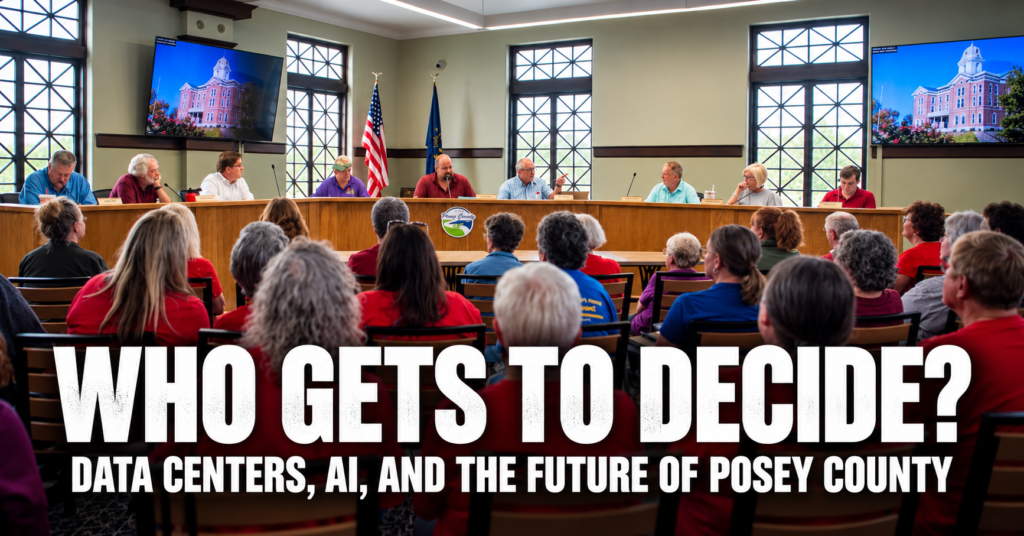
Protect Posey County has already demonstrated why participation matters. Members attended meetings, learned the governmental process, organized residents, conducted research and pushed for stronger protections. The Posey County Area Plan Commission ultimately recommended a nearly 40-page set of data center regulations addressing issues including height, noise, setbacks, utility use, construction and potential environmental effects. That recommendation did not approve a data center, and the proposal still has to move through the appropriate county and municipal legislative bodies, but the process itself shows what can happen when residents refuse to remain passive.
Jason said something near the end of the interview that stayed with me. A year ago, if someone had told him he would be attending government meetings, speaking publicly, studying ordinances and helping organize a community around data center policy, he would have thought they were crazy. Kristen described much the same experience. They did not have a playbook. They learned as they went.
That may be the most important story in the entire episode.
Democracy requires participation, and participation requires work. It requires people willing to show up at meetings that are often boring, read documents that are often difficult to understand, request records, ask uncomfortable questions and learn how government actually functions. None of that guarantees that citizens will get everything they want. But silence guarantees that decisions will be made without them.
The question at the center of Episode Two is not simply whether Posey County should have a data center. The bigger question is who gets to decide what progress looks like and how much say the people who live with its consequences should have in shaping it.
Kristen and Jason began this process because something enormous might be coming to their community. Along the way, they learned how much ordinary people can accomplish when they stop assuming somebody else is paying attention.
That is not fear of the future.
That is what participating in the future looks like.
Originally published by Fireside Aces Radio — read the original article →