Tommy J. Housman reflects on the lived experience behind the film, the classroom that made it possible, and the possibilities of working with less.
The Switch began with a real experience I could not ignore.
As many people know, my family went through a difficult period with rising utility bills here in Evansville, Indiana. I was doing everything I could to keep up. I was working, budgeting, making payments, and trying to spread each paycheck far enough to cover what we needed to survive the next two weeks. But the utility bill kept taking a larger and larger portion of that money. Eventually, the math stopped working.
When I needed help, many of the systems people are told to turn to either did not have enough funding available or I did not qualify. I made “too much money” for some forms of assistance, but not enough money to keep up with the actual cost of living. That gap is where many working people are trapped. They are employed. They are trying. They are doing what they are supposed to do. And still, they are falling behind.
I received help from people who cared about me. Friends, colleagues, and people in my community stepped in when I needed it. I am deeply grateful for that, but it also weighed heavily on me. I could not pay everyone back. Maybe someday I will be able to, but at that moment, I had to think about another kind of repayment: action.
That is why I started Gaslit: The Power of Story. I wanted to understand and explain what was happening with utility costs, monopolies, legislation, public testimony, and the people being harmed by these systems. The podcast became one piece of a larger community effort that included public testimony, advocacy, protest, direct action, and education. People spoke clearly. They said the increases were hurting them. They said they could not afford it. And still, the system moved forward. Our legislature ignored their constituents and the monopoly monster continued to feed on our community.
So, I kept thinking: what else can I do?
That question eventually became The Switch.
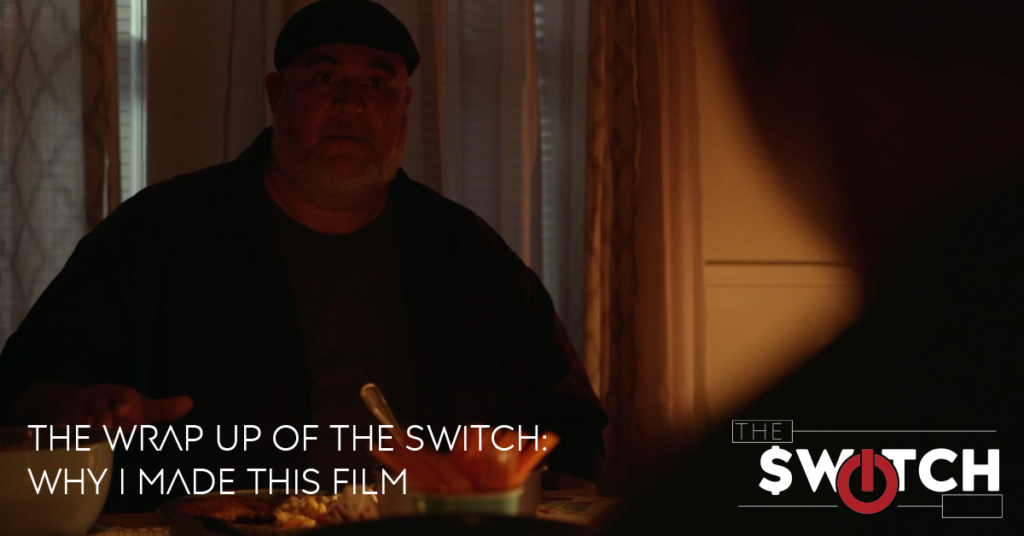
The film tells the story of a family celebrating a 21st birthday when the power is shut off. It is not a story about irresponsibility. It is a story about pressure. It is about a father trying to provide, children trying to navigate their own needs, and a family trying to hold itself together inside a system that keeps demanding more from people who already have very little left to give.
At the same time, The Switch became part of a larger teaching experiment.
Over the past two semesters, I have been developing a curriculum in which my video production class creates a complete short film in 16 weeks. The first semester was exploratory. This semester was more intentional. I wanted to build a repeatable model students could follow in future classes: concept, script, production, sound, editing, marketing, podcasting, articles, music, behind-the-scenes content, and a full digital hub to hold the project together.
That model connects to a larger curriculum I have been building around strategic communication, digital design, content creation, storytelling, ethical media practice, and social action. In my classes, I want students to understand not just how to make media, but why they are making it, who it affects, and how it can be used responsibly. We study how stories move through websites, podcasts, social media, video, audio, photography, writing, and campaigns. We also talk about how those same tools are often used unethically, and how they can instead be used to create empathy, understanding, and social good.
The Switch became a practical test of that idea.
Creatively, the film was an experiment in minimalism and improvisation. I wrote the bones of the story and the core dialogue, but I encouraged the actors to build around it. We talked through the emotional purpose of each scene, what each character needed, and what we wanted the audience to feel. Then we allowed space for the actors to respond naturally to one another. The goal was for the family to feel real, not overly scripted.
We also made the production itself as minimal as possible. One room. One house. One day.
Students arrived at my house around 1 p.m., and we worked until about 10 p.m. There were roughly 25 people in and out of the house throughout the day, including the video production students, actors, crew, and John Robertson’s sound class. We shot for about 10 hours straight. It was hot, crowded, and technically difficult.
The air conditioning in my house actually broke. The script was originally written to take place in winter, but because the house was so hot and everyone was visibly sweating, we adapted the story and shifted it to summer. I even had to write a wardrobe change into the film because my shirt was soaked. That became part of the reality of the story.
We also had equipment limitations. The cameras are good, but they are older, heavily used, and the batteries did not hold up the way we needed them to. There were shots I wish we could have captured, especially additional angles from the other side of the table before the power goes out. But the batteries were dying, the house was hot, time was running out, and we were not going to have another day to shoot.
That is the only major thing I would change: I would get a few more camera views.
But I also understand that those limitations are part of what made the project what it is. The whole point was to see what we could make with what we had. We did not have a full budget. We did not have perfect gear. We did not have unlimited time. We had students, creativity, collaboration, and a story that mattered.
And we made a film.
More than that, we built a full media project around it: the film, trailer, title sequence, original music, podcast episodes, video podcasts, articles, behind-the-scenes footage, promotional materials, social media content, and a complete project webpage. That page is not just for viewers. It is a template. Next semester, I can show a new class what this group built and say: this is the foundation. Now build on it.
That is the purpose of all of this.
The Switch is not only a short film. It is a story about economic pressure. It is a teaching model. It is a media campaign. It is a student learning experience. It is an experiment in minimalism, improvisation, and strategic storytelling. It is also my attempt to turn hardship into something useful.
I cannot undo what happened to my family. I cannot immediately fix the systems that continue to harm people. But I can tell the story. I can teach students how to tell stories. I can help them build the tools to use media with purpose, ethics, and care.
That is what The Switch represents.
It is one film, made in one room, in one day, during one semester.
But it is also the foundation for what comes next.
Originally published by Fireside Aces Radio — read the original article →