
TOMMY ART DESIGN · OPINION · NOVEMBER 27, 2026
This Is How We Know Trump and His Supporters Are Un-American
On Thanksgiving, compassion is more than a tradition. It is a measure of the character we should expect from ourselves—and from the people we entrust with power.
By Tommy Housman · Personal editorial
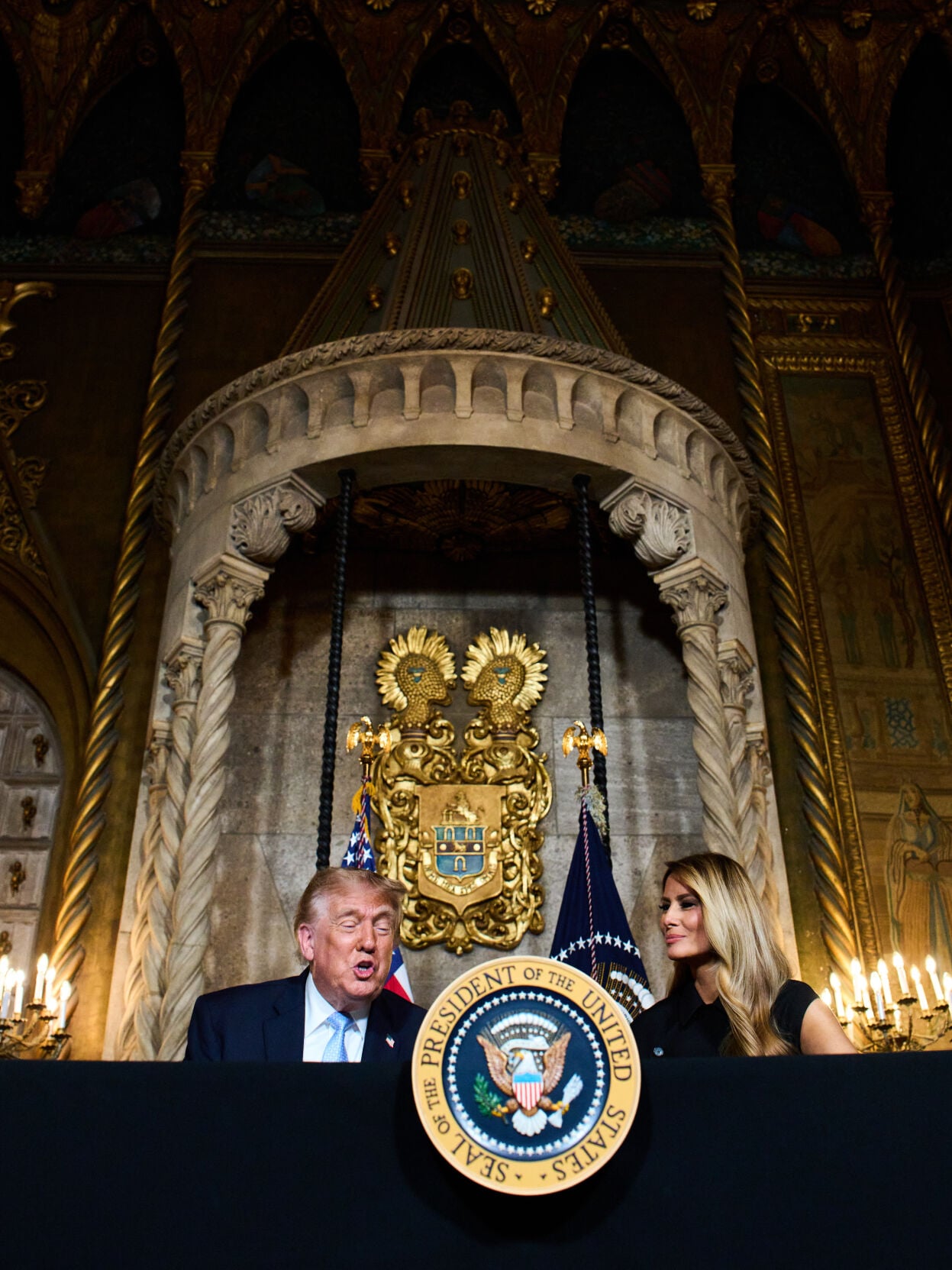
President Donald Trump and first lady Melania Trump speak to troops from Mar-a-Lago on Thanksgiving, November 26, 2026, in Palm Beach, Florida. Julia Demaree Nikhinson / Associated Press. Original photograph and caption.
Growing up, throughout my entire life, this time of year represented something particularly important. We amplified the qualities we were supposed to carry with us throughout the rest of the year: kindness, understanding, empathy, compassion and inclusiveness. We invited people into our celebrations who otherwise might not have had the opportunity to celebrate. We shared with each other, and we shared with strangers. We put on our nicest faces, spoke in our kindest voices and went to great lengths to ensure that kindness was what we were putting into the world.
When I think about those qualities, I think about what it means to be a man.
I've spent much of my life being physically bigger and stronger than most of the people around me. Perhaps that has influenced my understanding of strength. Perhaps growing up around violence influenced it, too. I've never considered my physical ability to intimidate someone, overpower them or force them into submission to be a measure of my manhood. The fact that I possess the physical ability to do something has never meant that doing it is right. I have always considered restraint, patience, compassion and the willingness to protect someone more vulnerable than myself to be greater demonstrations of strength.
Patience requires more discipline than losing your temper. Understanding another person's circumstances requires more intellectual effort than dismissing them. Standing between a bully and the person being bullied requires considerably more courage than standing behind the bully and cheering.
“Standing between a bully and the person being bullied requires considerably more courage than standing behind the bully and cheering.”
We don't live in the Wild West. We shouldn't have to fight one another for food, shelter or the basic necessities of human existence. Even under circumstances where survival was considerably more difficult, I would argue that cooperation and compassion would produce more meaningful and lasting results than aggression, intimidation and violence.
That is part of why I found the president's Thanksgiving message so disturbing.
The president's Thanksgiving message
On Thanksgiving Day, November 26, 2026, the president of the United States used a 461-word public message to attack political opponents, immigrants, people of Somali descent and members of his own federal government. He made accusations about criminality, unemployment, religious law and the manipulation of federal economic statistics. According to Reuters, he provided no evidence supporting those accusations.
On a day traditionally devoted to gratitude, generosity and bringing people together, the president chose to identify people toward whom his followers could direct their anger. He had an opportunity to encourage Americans to be kind to one another, to feed someone who was hungry, to invite someone into their home who otherwise might have spent Thanksgiving alone. He could have encouraged millions of people to do something good in the world.
Instead, he used the occasion to air his personal and political grievances. Reuters, November 26, 2026
As I sit here watching coverage of the president's Thanksgiving communications, including his interactions with American service members spending the holiday away from their families, I find myself thinking about the responsibilities of leadership. These are people making considerable personal sacrifices. Some are thousands of miles away from their children, spouses, parents and friends. I wanted to hear more about them, their experiences, their sacrifices and their families.
The presidency provides an individual with one of the largest communication platforms in the world. Every word spoken from that position has the potential to influence the behavior of millions of people. When a president repeatedly singles out entire populations for condemnation, I believe we have an obligation to examine what that rhetoric encourages and what we are communicating through our willingness to accept it.
When I turn on the television or open social media and encounter this kind of presidential communication, I'm embarrassed. I'm embarrassed that this is how our country presents itself to the rest of the world, and I'm embarrassed that treating other human beings with dignity has somehow become a subject of political disagreement.
What happened to our understanding of manhood?
I spend a considerable amount of time around women. Through those interactions, I've become increasingly aware of how frequently women have to alter their behavior because of the behavior of men. Women clutch their keys in their fists when walking to their vehicles. They avoid walking alone at night. They communicate their whereabouts to friends. They make decisions about where they can go, when they can go and whether they can safely go alone.
Consider the scale of the problem.
According to the Bureau of Justice Statistics, an estimated 560,890 rape and sexual assault victimizations occurred in the United States in 2024 among people age 12 and older. That amounts to approximately 1,532 victimizations every single day, including male and female victims and incidents that were never reported to police. This is an annual survey estimate of victimizations, not a count of unique victims; the daily average divides the estimate by the 366 days in 2024.
The CDC's 2016–2017 National Intimate Partner and Sexual Violence Survey also found that 94% of female lifetime rape victims reported exclusively male perpetrators. Among women reporting rape within the preceding 12 months, 97.7% reported exclusively male perpetrators.
Sources: Bureau of Justice Statistics, Criminal Victimization, 2024; CDC National Intimate Partner and Sexual Violence Survey.
What kind of conversation should men in this country be having with one another when sexual violence is occurring on this scale? Why aren't we discussing male accountability, emotional regulation, consent and respect every single day?
We've spent generations placing the burden of preventing sexual violence on women. We discuss what they were wearing, where they were going, how much they had to drink and why they were alone. We excuse male behavior with expressions like “boys will be boys.” We worry about whether holding a young man accountable might destroy his future while giving considerably less attention to the future of the woman whose life he has profoundly altered.
Men should be having these conversations with other men. We should be raising our sons to understand that their emotions are their responsibility. Their tempers are their responsibility. Their sexual behavior is their responsibility. Their ability to exercise power over another human being comes with an obligation to exercise restraint.
This is why I struggle so profoundly with the celebration of aggression and intimidation as characteristics of masculine leadership. Where are the men willing to challenge that behavior? Where are the men willing to stand between the bully and the person being bullied? When did compassion become something men are supposed to be embarrassed by?
Being a man, according to everything I have learned throughout my life, means protecting people. It means recognizing vulnerability and refusing to exploit it. It means being capable of examining your own behavior, admitting when you're wrong and changing your position when presented with information that demonstrates you were wrong.
It requires courage, intelligence and self-discipline. Those qualities should be expected of anyone occupying the presidency.
The people laughing at hunger
In a recent post, I published a story about people experiencing hunger, the increasing difficulty of affording food and the government policies affecting access to basic necessities.
Approximately 200 people laughed at it.
Many of the people leaving hostile comments appeared to be men. Some had locked profiles, some had no identifiable photographs of themselves, and others had very little original content or publicly available personal information. I cannot determine how many were authentic individuals, automated accounts or people deliberately attempting to provoke engagement.
Regardless of who was behind those accounts, somebody experiencing hunger should never be the subject of ridicule. The ability to express cruelty anonymously does nothing to make that cruelty more acceptable.
We have a serious problem with civic literacy, media literacy and the application of critical thinking. We have access to more information than any previous generation, yet many people deliberately restrict their consumption of information to material that confirms what they already believe. Algorithms can reinforce those habits, and political rhetoric can provide convenient explanations for complicated social and economic problems.
Understanding another person's circumstances requires us to consider information beyond our own experiences. One of the clearest examples of our failure to do that is the American workforce.
A person can overcome poverty. An entire population cannot do it through individual effort alone.
I have spent considerable time trying to explain to people that there are not enough adequately paying jobs in the American economy for everyone who needs one to have one. I have used employment statistics, wage statistics and cost-of-living calculations, yet people continue to respond with the same advice: get a better job.
Where?
According to the Bureau of Labor Statistics, there were approximately 7.5 million job openings in the United States at the end of September 2026. That figure represents openings across the nonfarm economy, including positions offering insufficient wages to meet an individual's basic living expenses.
Meanwhile, United For ALICE's 2026 national report found that approximately 54.5 million American households, representing 41% of all households in the country in 2024, earned insufficient income to afford their basic necessities. Approximately 38 million of those households earned above the federal poverty threshold but still could not afford the essential costs of living in their communities.
41.3% below the ALICE Threshold · 58.7% at or above it. Percentages calculated from the published household counts; report headline rounds to 41%.
Sources: Bureau of Labor Statistics, November 3, 2026; United For ALICE, 2026 National Report.
These measures describe different things: openings are jobs at a particular moment; ALICE counts households over a year. They cannot be divided to calculate a worker’s chance of upward mobility or, by themselves, prove a fixed shortage of adequately paid jobs.
Imagine the American workforce as a collection of cups. Each cup represents a job, and each person occupying a cup represents a worker. Some of those cups provide enough income to purchase food, maintain housing, afford healthcare, raise children and save for retirement. Others provide considerably less.
When the cups representing adequately compensated jobs are occupied, another person cannot occupy one without a vacancy being created. An individual might successfully navigate that system, acquire additional education, secure a promotion and improve their socioeconomic position. Their accomplishment deserves recognition. Jobs are also created and eliminated over time; this analogy describes competition for existing positions, not a permanently fixed number of jobs. However, their individual success does nothing to increase the total number of adequately compensated jobs available to everyone else.
Furthermore, the jobs they leave behind still need to be performed. Somebody still needs to prepare our food, clean our buildings, stock our grocery stores, care for our elderly and maintain our communities. We depend on these people every single day, yet we frequently tell them that their inability to afford basic necessities is a consequence of their individual choices.
I've been thinking about the story of Sylvester Stallone and Rocky, particularly with the new film I Play Rocky. Americans love stories about individuals overcoming extraordinary obstacles. We celebrate the person who rises from poverty, perseveres through adversity and ultimately succeeds.
I understand the appeal of those stories. What concerns me is our tendency to use one person's extraordinary accomplishment as evidence that an entire population should be able to accomplish the same thing under economic conditions that cannot accommodate everyone doing so.
Individual economic mobility and population-wide economic mobility are two fundamentally different concepts. You cannot solve a structural shortage of adequately compensated employment by telling every individual to compete harder for the positions that already exist.
We should also be considering what happens to those cups as businesses increasingly adopt artificial intelligence, automated manufacturing, industrial robots and autonomous software capable of performing tasks previously assigned to human beings.
In a peer-reviewed study published in the Journal of Political Economy in 2020, economists Daron Acemoglu and Pascual Restrepo found that increased exposure to industrial robots reduced employment and wages in affected American labor markets. Their research estimated that adding one industrial robot per thousand workers reduced the employment-to-population ratio by 0.2 percentage points and wages by 0.42%.
Technological advancement creates opportunities, but its economic rewards are distributed according to the systems we establish. As fewer people are required to produce certain goods and services, we need to confront what happens to the people whose livelihoods depended on performing that work.
Source: Acemoglu and Restrepo, Robots and Jobs: Evidence from US Labor Markets, 2020.
What is more valuable than a person's time?
One of my greatest frustrations with American capitalism is the disproportionate value we assign to financial investment compared with the investment of human time.
A business owner invests money. An employee invests hours, days, weeks and years of their existence. Both are essential contributions to the operation of a business, yet we have constructed an economic culture in which the person contributing money is frequently regarded as more deserving of the financial rewards generated by their combined efforts.
What is more valuable than time?
Every dollar a person loses carries at least the possibility of being earned again. Every hour a person sacrifices is gone forever. Most of us don't even know how much time we have left. Someone who spends 40 years working for a company has contributed a substantial portion of their existence to that enterprise.
I understand that operating a business involves financial risk. I understand that employees depend on businesses for employment and that businesses depend on employees to operate. That interdependence should give us an appreciation for the value of both contributions.
The federal minimum wage remains $7.25 per hour, where it has been since July 24, 2009. A person working 40 hours every week for an entire year at that wage earns $15,080 before taxes.
Seventeen years have passed without an increase in the federal minimum wage. The cost of housing, food, transportation and healthcare has not remained unchanged during those seventeen years.
Source: U.S. Department of Labor, Federal Minimum Wage.
Our government establishes the legal and regulatory conditions under which businesses operate. It determines minimum compensation requirements, tax obligations, labor protections, transportation investments, housing policies and the distribution of public resources.
Every one of those decisions influences the circumstances in which individuals are expected to survive.
When I advocate for laws that ensure access to nutritious food, affordable transportation, healthcare and housing, I do so because I recognize the enormous role government already plays in determining who has access to those resources.
We construct communities around automobile ownership and then expect people who cannot afford automobiles to navigate them. We build residential neighborhoods miles away from employment opportunities, grocery stores and healthcare facilities without necessarily providing the infrastructure to reach those destinations safely on foot, by bicycle or through public transportation.
We expect people to overcome obstacles that our own public policy decisions helped create, and then we condemn them when they struggle to overcome those obstacles.
Government and businesses should be accountable for the foreseeable consequences of their decisions. Personal responsibility should extend to the people designing and benefiting from our economic institutions, alongside the people working within them.
When more people do well, society does better
The idea that widespread economic security benefits society is supported by considerable economic research.
In 2014, International Monetary Fund researchers Jonathan Ostry, Andrew Berg and Charalambos Tsangarides examined the relationships between income inequality, redistribution and economic growth. They found that lower inequality was associated with stronger, more sustained economic growth and that redistribution generally did not produce the economic damage frequently attributed to it.
A 2015 report from the Organisation for Economic Co-operation and Development, In It Together: Why Less Inequality Benefits All, similarly identified widening income inequality as an impediment to economic growth. The researchers found that economic disadvantages among lower-income households restricted educational opportunities and the development of human potential, creating consequences for the broader economy.
The economic success of an individual business depends, in considerable part, on the ability of other people to purchase what that business produces. When families cannot afford their basic necessities, they eliminate discretionary spending. They stop eating at restaurants, purchasing new clothing, attending entertainment events and participating in activities that generate revenue for other businesses.
Giving people greater economic security creates opportunities for them to participate more fully in their communities and the economy.
Sources: International Monetary Fund, Redistribution, Inequality, and Growth, 2014; OECD, In It Together: Why Less Inequality Benefits All, 2015.
I struggle to understand why compassion and economic prosperity are so frequently presented as competing objectives. We can establish policies that allow businesses to prosper while ensuring the people performing the labor necessary for that prosperity can afford to live.
I don't expect business owners to impoverish themselves for the benefit of their employees. I expect them to recognize that their employees are human beings whose contributions have value beyond the minimum amount of money the law requires them to pay.
A society that values financial capital while disregarding human time has fundamentally misunderstood the source of its productivity and wealth.
“What is more valuable than time?”
The America I was taught to believe in
All of this brings me back to Thanksgiving and the message delivered by the president of the United States.
I grew up believing that there was something inherently American about helping your neighbors, extending opportunities to people who had fewer opportunities than you, protecting vulnerable people and giving something to someone without expecting something in return.
I believed that our collective strength came from the ability of people with different backgrounds, experiences and beliefs to coexist and contribute to something larger than themselves.
When I hear someone use the presidency to ridicule, intimidate or vilify other people, I think about those values. When I see people laughing at the misfortunes of hungry families, I think about those values. When I hear someone argue that people performing essential work are undeserving of the income necessary to survive, I think about those values.
And I wonder what happened to them.
I wonder how many men in this country have ever seriously examined their understanding of manhood. I wonder how many have considered the tremendous difference between possessing power and possessing the character necessary to exercise that power responsibly.
I want men to understand that there is strength in making someone feel safe. There is strength in listening to someone whose experiences differ from your own. There is strength in acknowledging when you have been wrong, especially after investing considerable time and energy in defending your position.
We should be capable of hearing someone's story without immediately searching for a reason why their suffering is their own responsibility. We should be capable of understanding that circumstances exist beyond our individual experiences and that our personal successes do not invalidate somebody else's struggles.
That requires us to examine the information we consume, the people we admire, the behavior we tolerate and the institutions we support. It also requires us to hold ourselves to the same standards we demand of other people.
I know what I want to contribute to the world. I want people to have food. I want people to have shelter. I want women to feel safe walking through their own communities. I want people who spend their lives working to have enough money to enjoy some portion of those lives. I want children to grow up understanding that kindness is something to aspire to and that compassion is among the greatest demonstrations of human strength.
Those are the American values I grew up celebrating around a Thanksgiving table.
Those are the values I expect the president of the United States to demonstrate.
And those are the values by which I will continue to judge the people we entrust with power.
Sources & methodology
This is a personal opinion essay. First-person experiences and social-media observations are the author’s account. Statistical sources use different populations and reference periods and should not be treated as interchangeable. The historical studies describe their study periods rather than forecasts for today. The illustrations above were prepared for this article from the cited data.
Bureau of Justice Statistics, Criminal Victimization, 2024
CDC National Intimate Partner and Sexual Violence Survey
Bureau of Labor Statistics, November 3, 2026
United For ALICE, 2026 National Report
Acemoglu and Restrepo, Robots and Jobs: Evidence from US Labor Markets, 2020
U.S. Department of Labor, Federal Minimum Wage
International Monetary Fund, Redistribution, Inequality, and Growth, 2014
OECD, In It Together: Why Less Inequality Benefits All, 2015
I Play Rocky — release information, Sylvester Stallone official website
Verification corrections: the daily victimization average uses 366 days for 2024; I Play Rocky is described as a new film rather than an upcoming release. The job-openings and household figures are presented with a comparability note. Featured photograph capture date and credit checked against its original publisher caption.